
A Market in Transition
The demolition of office buildings to be replaced by alternative uses was not born in the 2020s. In fact, Orange County experienced significant growth in this activity earlier in the 2000s, especially following the Great Financial Crisis, when the need for additional housing increased while older commercial space was becoming obsolete. Following another economic shock brought on by the COVID-19 pandemic, Orange County has seen a massive wave of demolition of office buildings to be replaced by multiple uses, primarily residential, multifamily, and industrial. Clearly, when the economy takes a hit and demand for office space declines, which is what happened following the two most recent economic resets, the motivation to replace these properties with higher demand uses increases.
Prior to COVID, Orange County’s 10-year historical office vacancy average was 14%, with a vacancy rate of 12.5% in Q4 2019, immediately before the pandemic. During those same 10 years, annual average leasing activity was 10.3 million square feet. After COVID’s onset, vacancy ballooned to approximately 19%, with average annual leasing volume dropping 25% to 7.7 million square feet. While the office market has recently shown signs of improvement, made evident by recording positive net absorption of 605K square feet combined in Q4 2025 and Q1 2026, leasing activity remains below pre-pandemic levels.
Demolition Activity Accelerates
What has resulted from the shift in office market dynamics? As demand has softened, developers have increasingly demolished under-performing office buildings and redeveloped those sites into higher and better uses. This trend has accelerated dramatically over the past decade. From 2016 through 2020, approximately 550,000 square feet of office space was demolished to accommodate alternative uses. Between 2021 and 2025, that figure increased to 2.68 million square feet—a 388% increase over the previous five-year period. Through the first half of 2026, approximately 590,000 square feet of office space has already been demolished, with an additional 5.4 million square feet planned for demolition during the second half of 2026 and beyond. Including both completed demolitions since 2016 and projects already planned, a total of 9.3 million square feet of office space is expected to be removed from the market.
Office Demolitions by Year
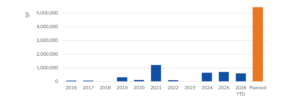
This trend has significant implications for office landlords throughout Orange County. Owners of underperforming office properties may have opportunities to sell their assets to developers for redevelopment, while landlords of well-occupied buildings benefit from a shrinking supply of competing office space, strengthening their ability to attract and retain tenants while supporting rental rates. Looking more closely at office buildings planned for demolition, a substantial amount of occupied space remains. Approximately 4.4 million square feet of office space slated for demolition is currently occupied, meaning a significant number of tenants will need to relocate. As these tenants seek replacement space, they are expected to boost occupancy levels in existing office buildings throughout the market.
Market Impact and What Comes Next

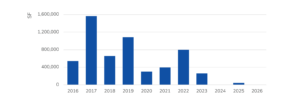
The demolition of office buildings is placing downward pressure on market vacancy by removing largely vacant space from the inventory. Vacancy has also been supported by a limited pipeline of new office construction. Since 2020, only 1.8 million square feet of office space has been delivered, and even when looking back to 2016, just 5.4 million square feet has been added to the market. By comparison, 16.7 million square feet was delivered between 2000 and 2008. Much of the newer inventory offers highly amenitized, modern office space, making it the preferred choice for many tenants. As a result, these properties have a vacancy rate of just 10.5%, well below the overall market vacancy of 16.1%, and continue to capture the majority of new leasing activity, resulting in positive net absorption.
New Office Deliveries
Let’s not forget that California has also imposed state-mandated housing requirements through the Regional Housing Needs Allocation (RHNA), placing pressure on cities to approve more housing. This makes rezoning office properties for residential or multifamily development a smoother process than converting them to many other land uses. While industrial redevelopment accounts for the largest share of office space slated for conversion in this analysis, much of that space was designated before the industrial market began to cool in 2023. Today, residential and multifamily development has become the most attractive redevelopment option for municipalities as they work to meet their RHNA housing obligations.
Stream has identified office properties totaling over 3 million square feet that are prime candidates or demolition and redevelopment into higher and better uses, further advancing this trend. As Orange County’s commercial and residential landscapes continue to evolve, these properties represent the next wave of transformation, reshaping where people work and live.
Evaluating your position in the Orange County market? Whether you are an owner considering redevelopment, an investor assessing opportunities, or a tenant planning for future occupancy, our team can provide tailored insight on how these shifts may impact your strategy. Reach out to learn more!