

“A generation whose every need has been catered to since birth. Now, when they finally face adulthood, they expect the gift-giving to continue… A generation raised on the principle of instant satisfaction simply can’t understand the concepts of long-term planning and deferred gratification.”
Or this:
“They’re lazy. They think basic tasks are beneath them. They’re a generation with a huge sense of self-entitlement.”
Or this:
“In the pantheon of virtues that made the U.S. great, none stands higher than the work ethic… Young adults are particularly choosy; many have little interest in the grinding routine… workers under 30 may in fact be too educated, too expectant… for the jobs that the economy offers them.”
If you assumed those quotes were about Gen Z, you have company. They read exactly like the commentary flooding business media today. But the first quote is from a 1993 Newsweek article about Gen X, titled “The Whiny Generation.” The second comes from a 2017 Daily Mail piece on Millennials. The third is from a 1972 Time essay about young Baby Boomers entering the workforce. Every generation, without fail, arrives at the workplace trailing the same accusations. And every generation, with time, proves them wrong.
The Pattern Is the Story
Gen Z—generally defined as those born between 1997 and 2010—is now entering their late 20s, while the youngest are still finishing high school. They are the first generation to have grown up entirely in the smartphone era, and they will make up roughly 30% of the American workforce by 2030.
That demographic weight has helped generate a substantial body of critical coverage. In February, HR Dive asked, “Is Gen Z really bringing mom and dad to interviews?” In March, the Wall Street Journal published “A New Lost Generation: Why Gen Z is Unprepared for the Workforce.” Polling has amplified the narrative: a 2023 ResumeBuilder survey of more than 1,300 managers found that 74% consider Gen Z more difficult to work with than other generations. A 2024 Zety survey found that only 9% of respondents rated Gen Z as the hardestworking generation, compared to 46% who chose Baby Boomers.
Headlines like these are real, the concerns they voice are felt by real managers, and they deserve engagement—not dismissal. But they also deserve context. And the most important piece of context is that this conversation is not new. It is, in fact, as old as the concept of a “generation” itself
Most Millennial professionals remember a near-identical wave of articles about themselves a decade ago. Before them, Gen Xers were tagged as slackers and cynics. In Big Shifts Ahead: Demographic Clarity for Business (2016), John Burns, CEO of John Burns Real Estate & Consulting, and Chris Porter, the firm’s Senior Vice President of Research, argue that generations are shaped by distinct combinations of government, economic, technological, and societal forces—which means every cohort genuinely is different from the last. What varies is not the fact of difference but what we do with it: too often, “different” gets flattened into “worse.”
It’s worth pausing on the Baby Boomers who top today’s “hardest-working” rankings. They are the generation that came of age singing along to The Who’s 1965 anthem “My Generation,” whose opening lyric is “people try to put us d-down, talkin’ ’bout my generation.” They knew exactly what it felt like to be dismissed by the people ahead of them. The cycle continues anyway.
What the Data Actually Show
When you move past perception polls and look at behavioral data, a more nuanced picture emerges.
On remote work: Gen Z wants the office more than their managers do.
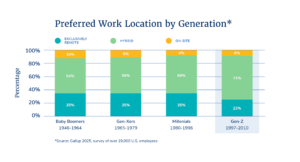
One of the most durable misperceptions about Gen Z is that they are the primary drivers of resistance to returning to the office. Senior leaders—often Gen X and Boomer—have raised legitimate concerns about younger workers missing mentorship, learning, and networking by staying remote. But the assumption embedded in those concerns—that Gen Z prefers remote work—is contradicted by polling.
Data from Gallup, Harvard Business School, Deloitte, and Morning Consult, going back to 2022, consistently find that Gen Z is the cohort least likely to want fully remote work. In Gallup’s 2025 survey of over 19,000 U.S. employees, fewer than 25% of Gen Z workers preferred 100% remote arrangements—significantly lower than every other generation:
On management: different path, same destination.
A 2024 report from the recruiting firm Robert Walters drew wide attention for its finding that 52% of Gen Z professionals said they don’t want to become middle managers, citing roles that feel high-stress and low-reward. The conclusion drawn in much coverage was that Gen Z has checked out of professional ambition.
The same survey, less widely covered, found that 72% of Gen Z respondents want to pursue entrepreneurial or independent career paths. That is not a rejection of ambition—it is a redirection of it. Worth noting: a 2015 Bentley University study found that 66% of Millennials at the same age also wanted to start their own businesses.
And when you look at what actually happens rather than what young workers say they prefer, the generational panic dissolves. Glassdoor data show that 14% of Gen Z workers are already in management roles by age 27—virtually identical to the rates for Millennials (13%), Gen X (14%), and Baby Boomers (12%) at the same age. The pipeline is working
On AI: the latest version of a familiar argument.
Gen Z is the first generation entering the workforce with large language models, automation software, and AI-assisted workflows already woven into their daily work. This has prompted renewed concern that younger workers are becoming over-reliant on tools and losing foundational skills.
That argument has predecessors. Earlier generations were criticized for relying too heavily on calculators, spreadsheets, and eventually the internet and email—each framed as evidence that younger workers were becoming less capable rather than simply more adapted. The pattern is consistent: the youngest workers adopt new tools fastest, and that speed is initially read as dependency rather than proficiency.
What Gen Z Actually Brings
The more productive managerial question is not “What’s wrong with Gen Z?” but “What shaped them, and how do we work with that?”
Gen Z came of age during a period of compounding disruption: the 2008 financial crisis shaped their childhood, smartphones restructured their adolescence, a pandemic interrupted their transition to adulthood, and AI is now reshaping the professional landscape they’re entering. That’s not a recipe for fragility—it’s a description of a cohort that has been stress-tested before most of them held their first full-time job.
The traits that read as friction in performance reviews—directness about compensation, skepticism of undefined “culture,” preference for explicit feedback over implicit hierarchy— often reflect a generation that learned early not to assume stability. They are, in many respects, exactly what a risk-aware organization should want: employees who ask whether the work is sustainable, who want clear metrics, and who are less likely to smile through dysfunction until it becomes a retention crisis.
They also arrived fluent in the tools that are reshaping every industry. Organizations that treat that fluency as a threat are misreading the asset in front of them.
A More Useful Frame
None of this is to say that every criticism of young workers is unfounded. Genuine differences exist between generations—they always have—and some of the behaviors described by managers are real and worth addressing. Early-career workers in any era benefit from mentorship, structural feedback, and clear expectations. That is a management challenge, not a generational indictment.
The more honest framing is this: when 74% of managers say Gen Z is difficult to work with, that tells us something true about the friction of this particular generational transition. It does not tell us that Gen Z is uniquely deficient—because the same number, expressed with equal conviction, has been attached to every generation that preceded them.
The managers who will get the most from this generation are the ones who stop asking, “Why won’t they just work the way we work?” and start asking, “What do they know that we don’t?”